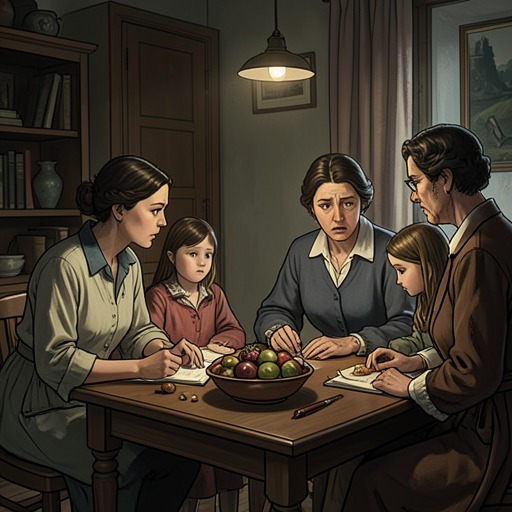
The Walker family’s bereavement
The Sky Is EverywhereThe Walker family’s bereavement is the shared aftermath of Bailey’s sudden death, a loss that leaves Gram, Lennie Walker, and Big struggling to inhabit the home and routines they once shared with her. It is not a single stage of mourning but a changing condition: the family withdraws from ordinary life, reaches for Bailey through her belongings and recorded voice, and eventually begins to make room for a future in which grief remains inseparable from love.
The death and its immediate aftermath
Bailey dies at nineteen from a fatal arrhythmia while rehearsing for a local production of Romeo & Juliet. The family’s grief is measured against the ordinary moment that preceded the news. Lennie had been doing chemistry at Bailey’s desk, impatient for her sister to come home for dinner, when the phone rang. Remembering that she had been thinking about food and schoolwork while Bailey was dying elsewhere becomes a painful measure of how abruptly the everyday world continued without warning.
Four weeks after the death, Gram is already worried about Lennie’s emotional state, but she also watches a particular houseplant whose black spots she believes reflect Lennie’s physical, emotional, and spiritual well-being. Lennie has come to share that belief. The plant makes private distress visible in the household: Gram’s concern for it is also concern for Lennie, while its worsening condition follows a course that Gram’s gardening skill cannot control.
The family’s first response is a kind of stunned immobility. Gram, Big, and Lennie sit together, each with unruly hair, staring at nothing through the afternoon. Lennie describes their lives as though the horizon had been taken away. By the time school has been out for two weeks, the three are instead moving in opposite directions through the park, a change from shared stillness to separate, unsettled ways of enduring the same loss.
A household organized around absence
Grief alters Gram’s daily life as well as Lennie’s. Ordinarily occupied with her work as Clover’s Garden Guru, Gram puts her clients on hiatus until fall and follows Lennie from home to Maria’s Deli, the library, and Flying Man’s. At the swimming place she paces while Lennie floats on her back and cries. Her attention is persistent, but Lennie does not want conversation or the afternoon tea that once joined them at the kitchen table. Care cannot immediately restore their old closeness; it can become another pressure when the person being cared for needs silence.
Bailey’s room makes that conflict concrete. Her dresses remain on a chair, a towel hangs over the bedpost, and her laundry basket is still full of dirty clothes; a hairbrush holds strands of her hair, and gum wrappers lie scattered nearby. Gram suggests packing some things away. Lennie says she will do it, but asks Gram to stop following her and leave her alone. Gram accepts the rebuke, and Lennie recognizes that she has hurt her. Later, Lennie hears Gram prolonging her showers, understanding that Gram is trying to cry where Big and Lennie will not hear her. The room’s preserved disorder and Gram’s concealed tears show how each is grieving within the same house but not in the same way.
Lennie’s mourning also reaches beyond the immediate family. Her mother, Paige Walker, has been absent for sixteen years, and the family story of the restless gene—women who leave and eventually return—has helped explain that absence without resolving it. Bailey had pursued questions about their mother from childhood. In Bailey’s room, Lennie finds a drawing of an Explorer Mom, a remnant of that search, and later learns that Gram wrote letters to Paige. Bereavement therefore intensifies an older family uncertainty: the loss of Bailey sits beside the unresolved absence of their mother.
Reaching for Bailey
Lennie repeatedly tries to make contact with the sister who can no longer answer. After discovering that Bailey’s phone account is still active, she calls the number again and again to hear Bailey’s recorded greeting. On one call, she asks why Bailey had not told her she was getting married. That question exposes how much Lennie did not know: despite their closeness, Bailey had been carrying news and plans that had not yet been shared with her. The call offers a moment of Bailey’s voice, but it also sharpens the distance between what Lennie longs to ask and what can no longer be explained.
The family’s grief also finds expression in physical and creative acts. Lennie’s thoughts about sex and intimacy become newly insistent after Bailey’s death, confusing her and heightening her sense of being changed. At Flying Man’s, Toby describes the wedding Bailey had wanted there: after the ceremony, the guests would jump into the pool. Lennie imagines the celebration that will never occur, and she and Toby, both grieving Bailey, kiss. Their closeness arises from shared knowledge of the loss, not from a simple return to ordinary happiness. Lennie gives this experience a poetic form, describing him as someone who knows the architecture of her house of grief and can walk there with her.
That grief does not keep Lennie entirely apart from the living. After practicing Cavallini’s Adagio and Tarantella for two hours, she speaks with Sarah, whose anger at their estrangement mingles with the summer news she has missed. Lennie has begun to feel music as a way of turning air into color and considers attending summer band practice. Music and friendship do not cancel her mourning; they mark moments when attention can move outward again.
Grief carried into the future
Lennie becomes uneasy at the possibility that she might have been happier, though less intensely alive, if Bailey had survived. She imagines her former self as a turtle within a shell and wonders whether her new openness—to music, feeling, and the world—has emerged at an unbearable cost. The thought troubles her because she does not want Bailey’s death to seem worthwhile or productive. She finds a different way to understand the change by remembering that Bailey had urged her to come out of her shell: Lennie can learn from Bailey’s life rather than assign a benefit to her death.
Later, Lennie recognizes that having a future while Bailey does not will remain an unbearable fact. She does not conclude that grief disappears. Instead, she understands it as something that will recur throughout her life, inseparable from her continuing love for Bailey. This recognition allows happiness and sorrow to coexist without making happiness a betrayal or grief evidence that life has stopped.
After baking with Gram, Lennie runs through the woods toward the cemetery, feeling the fabric of death that has clung to her begin to loosen. She visits Bailey’s grave for the first time and rests against the warm stone, chosen so Bailey could be near the river. Its small cabinet holds a notebook in which Lennie has transcribed Gram’s letters to Paige, preserving a family history Bailey should remain part of. Inside, Lennie finds an orange-topaz ring Toby had made for Bailey and understands it as part of the marriage and pregnancy news the couple had meant to announce. She kisses the ring and returns it beside the notebook.
Lennie brings the failing houseplant to the falls, removes it from its pot, and throws it into the water. Because the plant has long served as a measure of her well-being, this final act gives the household’s grief a concrete, changed image; it does not undo the loss or establish that Lennie is finished mourning. The family’s movement toward life instead lies in learning to carry Bailey’s absence alongside memory, music, affection, and the future.